
News
01
2024
-
11
Introduction of Hydraulic Beam Shifting Solution

1.In the erection of the entrance and exit bridges of the culvert, the bridge erection equipment cannot be erected in place at one time for the adjacent bridges, and the pier top must be manually moved horizontally to position them. The traditional method is to lay a long steel plate on the supporting pad stone as a slideway, and then drop the bridge and the support on the round steel roller on the slideway, and manually cooperate with the hand chain hoist (track chain) to slide the beam. This method has many disadvantages and safety hazards. First, it is unstable. The contact area between the support and the roller is small, which affects the stability of the beam shifting; second, the process is cumbersome, and the roller needs to be constantly switched, and the operation efficiency is too low; third, the structure of the support is destroyed. The KTYZM cylindrical steel support currently used is highly mobile, and the temporary connection cannot withstand the forces of different nature and size from all directions during the beam shifting process, which easily leads to structural deformation and affects the use; fourth, the beam shifting speed is slow, the labor intensity is high, and there are many users, and the coordination is poor. Therefore, the traditional beam shifting method can no longer meet the current efficient, economical and safe construction methods. Hydraulic beam shifting can overcome the above problems and has many advantages. The construction method has undergone a fundamental change.
2. Design purpose and principle of hydraulic beam shifting device:
1) Increase the stability of beam shifting to ensure construction safety;
2) Increase the speed of beam shifting;
3) Optimize the personnel structure of beam shifting on the pier top to reduce labor intensity;
4) The new beam shifting device requires a simple structure, economical and applicable, easy on-site operation, safe and reliable.
3.Main components of two-way jack: Hydraulic pump, hydraulic lifting jack

Vertical lifting: The vertical jack is double-acting, and the two-point layout ensures the balance of bridge lifting. (Vertical jacks are available in double 80t and double 100t).
Horizontal movement mechanism: It uses a two-way single-stage oil cylinder to reciprocate.
Frame: It uses Q355 structural steel
System pressure: 50Mpa ultra-high pressure system.
Manual or intelligent control is adopted, and single control is combined with multiple control.
The multi-channel electric oil pump is the power and control part of the steel bar stretching equipment, and is the power and control equipment for supporting YDC/YDT and other jacks. It can also be used with various other forms of low-flow, high-pressure jacks and hydraulic machinery. The multi-channel electric oil pump is the power and control part of the steel bar stretching bridge lifting and the lateral movement of objects. It uses a distributor with two or more interfaces to drive two or more jacks at the same time. Each jack can adjust the oil intake separately, so that the lifting height of each jack is different, and the parallel movement of the lifting work is maintained. Greatly improved work efficiency and reduced equipment costs
4. Features and precautions of the hydraulic system for precise pressure regulation in two-dimensional space
1. High adjustment accuracy. The adjustment and positioning accuracy of the two-dimensional space X-axis/Z-axis can reach 1mm, or even higher accuracy.
2. The system is easy to carry. After simple training, operators can master the operation and achieve the expected adjustment accuracy control.
3. The system adopts electric hydraulic pump station control to improve labor efficiency. It can also be controlled by manual hydraulic pump to adapt to working in a power-free environment.
4. For new or long-standing electric hydraulic jacks, there is a lot of air in the cylinder. When it is used for the first time, the piston rod may have a slight jump phenomenon. The ultra-high pressure electric hydraulic jack can be reciprocated 2-3 times without load to remove the air in the cavity. For electric jacks that have been idle for a long time, the seals are hardened due to long-term non-operation, which affects the service life of the ultra-high pressure electric jacks. Therefore, when the ultra-high pressure electric hydraulic jacks are not in use, the ultra-high pressure electric hydraulic jacks should be reciprocated 2-3 times without load every month.
5. The high-pressure oil pipe is tested at 105Mpa (1050Kgf/cm2) before leaving the factory. However, since the hose is easy to age, users need to check it frequently, usually every six months, and three months for frequent use. During the inspection, use 87.5Mpa (875Kgf/cm2) for pressure testing. If there are bursts, bulges, leakage, etc., it cannot be used.
6. The technical specifications should be strictly followed during operation, and users should regularly check and maintain according to the usage.
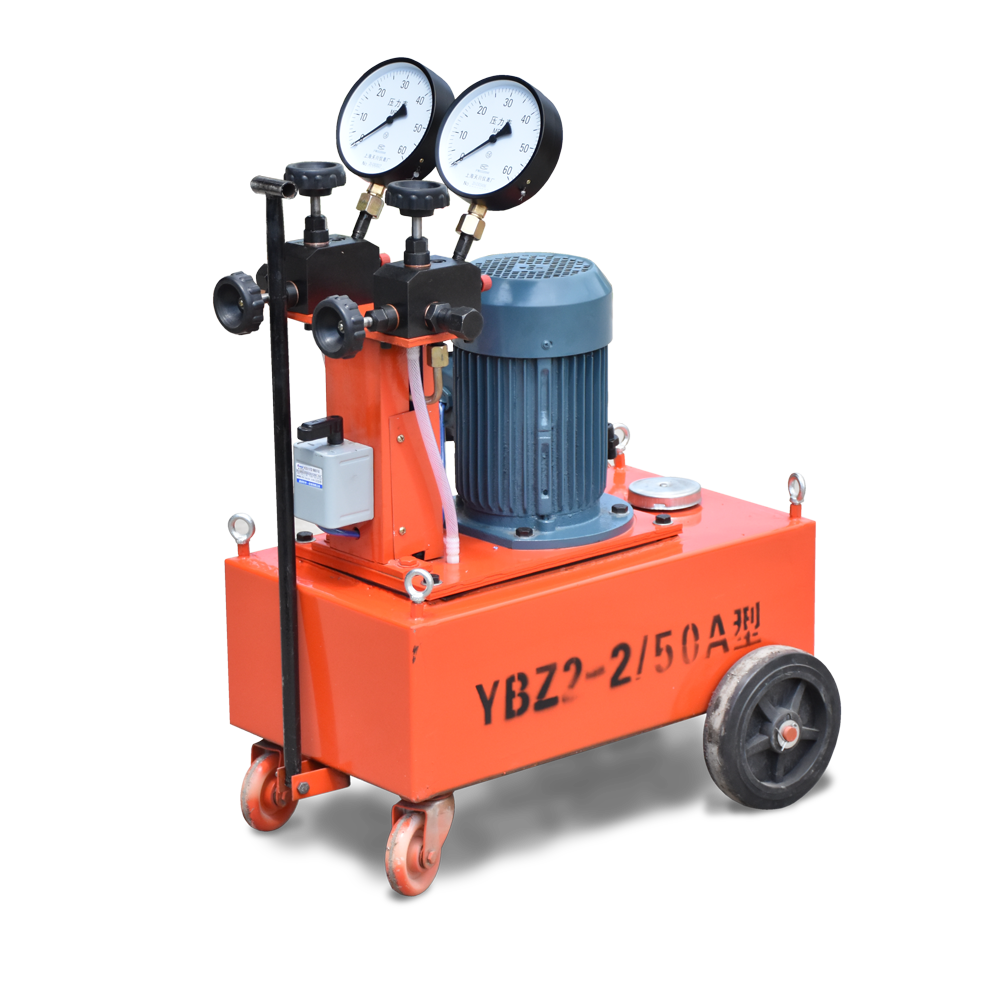
5. Principle of hydraulic beam shifting:
The principle of hydraulic transmission is to use oil as the working medium, transmit motion through the change of sealed volume, and transmit power through the pressure inside the oil. The hydraulic cylinder uses a manual booster rod (hydraulic manual pump) to allow the hydraulic oil to enter the cylinder through a one-way valve. At this time, the hydraulic oil entering the cylinder cannot be reversed due to the one-way valve, forcing the cylinder rod to rise, and then continue to make the hydraulic oil continue to enter the hydraulic cylinder during work, and it continues to rise. When it is time to lower, open the hydraulic valve to return the hydraulic oil to the oil tank. The five basic components of the hydraulic cylinder are the cylinder barrel and cylinder head, piston and piston rod, sealing device, buffer device and exhaust device.
The hydraulic beam shifting mainly relies on the hydraulic cylinder to provide power through the movement of the live rod to move the bridge placed on the slide in advance from the starting position to the predetermined position. The hydraulic beam shifting can be explained from the following figure and several simulation links:


Single-rod hydraulic cylinder, inner diameter of hydraulic cylinder (90mm for 32t, 110mm for
50t), stroke 300mm, practical working pressure 6-50MPa Due to the cylinder stroke limit, the
double vertical support jack is raised and lowered once in one stroke. According to the actual
situation on site, one support is not always a full stroke. Different line spacing usually requires N
reciprocating supports. The good condition of the slideway is crucial to the life of the cylinder.
The slideway must be lubricated before the beam is dropped, and the verticality of the beam in
the longitudinal and transverse directions must be checked to avoid additional load on the
cylinder due to the beam or slideway, which may cause damage to the cylinder.
Note: The bottom of the beam jack cannot be covered with soft and uneven materials to increase the height.

The whole process from the jack being put in place to the beam being moved horizontally to the designed position can be roughly divided into six steps. Each step is a stroke and one support. Each time the support is changed, the jack status needs to be observed to see if there is leakage or deflection. Move the beam to the designed position; according to the 2101 beam design document of the Second Railway Institute, for bridges with a line spacing greater than or equal to 5m, the two lines are arranged in parallel as single lines. For bridges with a line spacing of 4.2m~5m, the line spacing requirements are met by adjusting the width of the middle wet joint. We can make fine adjustments based on the value of the line spacing. If the bridge piers with a line spacing of more than 5m are not designed separately, it has been proven that the above method can also be used to adjust the layout and successfully complete the beam moving task. For the same beam, in terms of construction time, the traditional beam shifting method takes at least one hour to put it in place, while the hydraulic beam shifting method only takes 20 to 30 minutes, which greatly speeds up the erection of the bridge; in terms of construction safety, due to the limitation of construction machinery, the speed of the beam shifting at both ends of the traditional beam shifting method cannot be synchronized, and the roller axis is highly mobile and cannot be effectively controlled, which poses a great safety hazard, while the synchronization and effective controllability of the hydraulic beam shifting method are much higher than the traditional beam shifting method, which improves the construction safety factor; in terms of labor use, the traditional beam shifting method requires 6 to 7 people on each pier, while the hydraulic beam shifting method only requires 3 to 4 people, which reduces the number of people and saves labor costs.

Through our company-Kaifeng Dafang Prestressed Co.,Ltd years of research and development, production and bridge erection practice, it has been proved that compared with the traditional beam shifting method, the hydraulic beam shifting method not only speeds up the construction progress of the track laying and improves the efficiency of personnel use, but also greatly reduces the intensity of labor, ensures construction safety, and creates considerable economic benefits. we believe that in the subsequent beam erection process, we will continue to summarize experience and improve the hydraulic beam shifting process to make the hydraulic beam shifting technology more mature.

Latest News

—
Sep 15,2021
Leave A Message

All products are selling well in both domestic and abroad.We also welcome OEM and ODM orders.
Contact Us
 info@hndfyyl.com
 +8615093660266
 Luhuagang turntable 50 meters, Yuwangtai District, Kaifeng, Henan Province, China
Copyright © Kaifeng Dafang Prestressed Co, Ltd. All Rights Reserved. Powered by:www.300.cn SEO Privacy Policy
Copyright © Kaifeng Dafang Prestressed Co, Ltd. All Rights Reserved.
TOP
在线留言